Why diets stall: what the research says about fat-loss plateaus
The scale stops moving and you wonder what broke. What studies say about the 3,500-calorie rule, a slowing metabolism, hunger, muscle, diet breaks and water.
In this article
- The week the scale stopped
- The 3,500-calorie rule is too neat
- Does your body turn the burn down?
- Hunger changes too
- What losing faster can cost
- Do diet breaks help?
- The scale tells you about all of you, water included
- Exercise and spot reduction
- The unglamorous tool: keeping track
- What to take from all this
- How Chiron helps with this
- Sources
The week the scale stopped
The first weeks go well. Then the number on the scale stops moving, even though you are eating the same way. It is easy to decide that something is broken: your metabolism, your willpower, or both.
The research gives a less dramatic answer. A slowdown is expected. Part of it is arithmetic, part is the body pushing back, part is how hard a long diet is to follow, and part is the scale itself. This article goes through the main studies on each, with their numbers and their limits, because many are small and none is your personal plan.
The 3,500-calorie rule is too neat
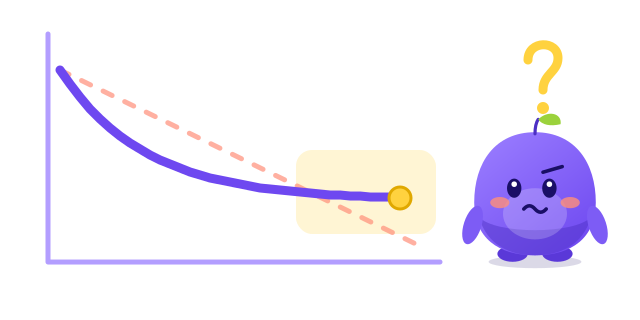
You have probably heard that 3,500 calories equal one pound of body fat, so a deficit of 500 calories a day means one pound lost a week, week after week. It sounds tidy, but it treats the body like a bank account that never reacts.
- Hall and colleagues, 2011. A mathematical model of adult metabolism, published in The Lancet, lets energy expenditure adapt as weight changes. Its headline result is that the bodyweight response to a change in food intake is slow, with a half-time of about one year. In plain words (our reading, not a quote), as you get lighter the same cut changes your weight a little less, so the curve bends.
- Thomas and colleagues, 2013. They tested the old rule against seven weight-loss experiments, run in confinement or with objectively measured intake. The rule grossly overestimated actual weight loss, and a dynamic model was significantly more accurate.
So a slowing curve is exactly what a dynamic model predicts. It is not, by itself, proof that you are doing something wrong.
Does your body turn the burn down?
This is the part scientists argue about. When you eat less, does your body spend less than your new weight and body composition would predict? The term is adaptive thermogenesis, and the studies disagree on how big it is.
- Rosenbaum and colleagues, 2008. In a hospital unit, 21 people on the same liquid diet formed seven trios: one at their usual weight, one who had recently lost 10% or more, one who had kept that loss off for over a year. Energy expenditure was lower in both weight-reduced groups, by a similar amount after a few weeks and after more than a year.
- Redman and colleagues, 2009 (CALERIE). Forty-eight overweight adults, in four groups, for six months. In the groups that cut calories, total energy expenditure came out lower than their new body composition predicted: about 430 kcal a day at three months, about 240 at six. Energy spent on daily activity was lower too. In the group that combined a smaller cut with exercise, adjusted expenditure did not drop at either point.
- Fothergill and colleagues, 2016. Fourteen contestants of the TV show The Biggest Loser lost about 58 kg on average in 30 weeks, and 41 kg of it came back over six years. Their resting energy burn was still about 500 kcal a day below what their body composition and age predicted. The authors called it a proportional, but incomplete, response to efforts to reduce body weight.
- Martins and colleagues, 2020. In 171 overweight women who lost an average of 12 kg, adaptation right after weight loss was about 54 kcal a day, and in the women followed throughout it was gone at one and two years, once weight was stable. A second study put 71 people with obesity on a strict eight-week diet: about 92 kcal a day at the end, and about 38 after four weeks of stable weight. Neither found that adaptation predicted who regained.
These studies differ in who they followed and how they measured, so the numbers are not directly comparable. In the Martins studies, adaptation was bigger while people were still losing and smaller once weight had steadied. Two reviews put the debate in perspective. Dulloo and colleagues (2012) wrote that the question is no longer whether adaptive thermogenesis exists, but how much it matters, and that it is hard to measure precisely. Heymsfield and colleagues (2007) found that low-calorie diets give less than half the weight loss that models predict, which they put down, by deduction, mostly to adherence and to a lesser degree to metabolic adaptation.

The honest picture has two parts: a real pull from the body, whose size is still debated, and everyday adherence, which is hard to sustain.
Hunger changes too
Another reason a long diet gets harder is that appetite signals shift.
Sumithran and colleagues (2011) enrolled 50 overweight or obese people in a ten-week programme built on a very-low-energy diet. They lost about 13.5 kg on average. Afterwards, leptin and peptide YY were lower, ghrelin was higher, and so were their ratings of hunger and appetite. A year later, those levels had still not returned to where they started, and hunger was still higher than at baseline. A review by MacLean and colleagues (2011) called this biological response to weight loss comprehensive, persistent and redundant.
The limits are real. This was one programme with a very-low-energy diet, and it measured hormones and appetite ratings, not what people went on to eat.
What losing faster can cost
If a slower loss is more comfortable, is a faster one worth it? The trials that look at muscle say there is a price.
- Garthe and colleagues, 2011. Twenty-four athletes, all lifting four times a week, were randomized to lose 0.7% or 1.4% of their body weight per week. Both ended about 5.5% lighter, the slower group in around 8.5 weeks and the faster in around 5. The slower group lost about 31% of its fat mass against 21%, and gained about 2% in lean mass, while the faster group’s lean mass did not change. These were athletes, a small sample, and the same team’s follow-up found no significant difference between the groups after twelve months.
- Murphy and Koehler, 2022. A meta-analysis of trials of lifting in an energy deficit found that lean-mass gains were impaired compared with lifting without a deficit (effect size -0.57), while strength gains were comparable. The authors advised against deficits above about 500 kcal a day for people trying to preserve muscle.
- Longland and colleagues, 2016. Forty young men trained six days a week for four weeks on a diet about 40% below their needs. The group eating 2.4 g of protein per kg of body weight gained about 1.2 kg of lean mass and lost 4.8 kg of fat, against 0.1 and 3.5 kg on 1.2 g per kg. It was short, intense and closely controlled, and the authors called it a proof of principle, not a template.
- Morton and colleagues, 2018. In lifting studies, protein beyond about 1.6 g per kg per day gave no further gain in fat-free mass. That was about building muscle, not dieting, so treat it as a rough reference.
Do diet breaks help?
If the body pushes back during a long diet, what if you built in pauses? That is the idea of diet breaks, or intermittent energy restriction.
- MATADOR (Byrne and colleagues, 2018). Fifty-one men with obesity dieted for 16 weeks, either continuously or in two-week blocks alternating with two-week blocks at maintenance. Among those who completed the protocol, the intermittent group lost more (14.1 kg against 9.1, with 12.3 kg of fat against 8.0) and their resting energy drop was smaller, about 86 against 179 kcal a day. But these were men with obesity, and the intermittent plan ran for 30 weeks in total.
- ICECAP (Peos and colleagues, 2021). Sixty-one resistance-trained adults did 12 weeks of continuous moderate dieting, or four three-week diet blocks separated by one-week breaks. Fat mass, body weight and fat-free mass ended up similar, but the break group reported less hunger and less desire to eat.
- Headland and colleagues, 2016. A review of nine studies and 981 people, in trials lasting six months or more, found neither intermittent nor continuous restriction superior for weight loss. The authors noted that the trials were few and small, typically under 50 completers.
So breaks do not clearly speed up fat loss. Some people may find them easier to stick to, which is our inference from the hunger result, not something these trials measured. The evidence is mixed and mostly short term.
The scale tells you about all of you, water included
Before you call a stall, remember what the scale measures.
Glycogen, your stored carbohydrate, is held with three to four parts of water for every part of glycogen, according to Kreitzman and colleagues (1992). They discussed how this water-laden glycogen affects weight fluctuations during dieting, including an exaggerated regain when carbohydrate loading occurs. Our reading: a fast early drop can partly be water, and a quick rebound does not have to mean fat came back overnight.
Day-to-day noise is large and regular. Orsama and colleagues (2014) had 80 adults record 4,657 daily weights. Weight was higher early in the week, on Sunday and Monday, started rising on Saturday, and began falling on Tuesday. The pattern was strongest in people who lost or maintained weight, and the authors concluded that weekend-to-weekday variation should be considered normal. Turicchi and colleagues (2020), in over 1,400 people, found weekly swings of about 0.35% of body weight, and a Christmas rise of about 1.35% that was not fully compensated later.
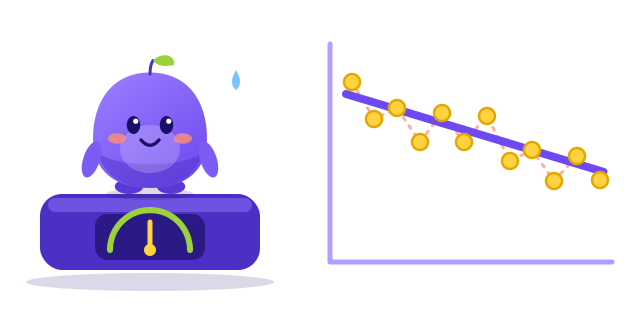
That is why the trend over weeks tells you more than any single morning.
Exercise and spot reduction
Can you simply burn through a plateau? Exercise helps, but less simply than it sounds.
- Careau and colleagues, 2021. Pooling data on 1,754 adults living normal lives, they found an average energy compensation of about 28%: only about 72% of the extra calories burned through activity showed up as extra calories burned that day. This is observational data, and the authors say the causes are still open.
- Swift and colleagues, 2018. A review concluded that the minimum guideline of 150 minutes of moderate activity a week is generally inadequate for clinically significant weight loss without cutting calories too.
- Wewege and colleagues, 2022. A systematic review of 58 trials found that resistance training reduced body fat percentage by 1.46 and fat mass by about half a kilogram, compared with no exercise. Exercise is far from pointless.
Targeting one body part does not seem to work in the trials that tested it. Vispute and colleagues (2011) had 24 adults do abdominal exercises five days a week for six weeks: no significant change in belly fat, though curl-up endurance improved. Ramirez-Campillo and colleagues (2013) had 11 people train one leg for 12 weeks: total fat mass fell about 5%, yet the trained leg showed no significant change. Both were small, but they point the same way: working a muscle does not choose where the fat comes off, at least in these trials.
The unglamorous tool: keeping track
A 2011 systematic review by Burke and colleagues covered 22 studies of self-monitoring (15 on food, six on weighing yourself, one on exercise). It found a consistent link between self-monitoring and weight loss, but rated the evidence as weak because of methodological limits, such as samples that were mostly white women and heavy reliance on self-report.
Harvey and colleagues (2019) followed 142 people in a 24-week online programme who logged their food. Those who lost 5% or more opened their food journal about 2.4 times a day, against 1.6 for those who lost less. The time needed shrank, from about 23 minutes a day in the first month to about 15 by month six. Both findings are associations. It may be that people who are doing well simply log more, not only the other way around.
What to take from all this
- Expect a slowdown. The maths bends, and the old 3,500-calorie rule overestimates. A flattening curve is not a verdict on you.
- Know that your body pushes back, by an amount still debated. Everyday adherence plays a big part too, so a plan you can follow beats a heroic one.
- Go slower if you want to keep muscle. In the trials, slower losses, lifting and higher protein went with better lean mass, though mostly in athletes and young men. Do not copy their numbers on your own.
- Treat diet breaks as an option, not a proven upgrade. Some people may find them easier, and they do not clearly speed up fat loss.
- Judge the trend over weeks, not one morning. Water and the day of the week both move the number.
- Keep tracking, and keep lifting if you can. Tracking is linked with better results and strength training helps body composition, though much of this evidence is associations.
How Chiron helps with this
Chiron’s calorie target starts as a formula, and a formula can miss for a real person. After a few weeks of logging food and weighing in, Chiron can estimate your real maintenance from your own data and offer to update your target. You decide whether to accept. It waits for enough data before saying anything, guards against the early water drop, and runs on your phone. How it works is in How Chiron’s calorie target adapts to your body.
It is a wellness app and not a medical device, and it makes no promise about how much weight you will lose. If you have a health condition, a history of an eating disorder, or you are pregnant or breastfeeding, talk to a doctor or a dietitian before you change how you eat. Several of these studies were small, closely supervised, or done in specific groups, and none of this is a personal calorie target.
Sources
- Hall KD, et al. Quantification of the effect of energy imbalance on bodyweight. The Lancet, 2011.
- Thomas DM, et al. Can a weight loss of one pound a week be achieved with a 3500-kcal deficit? International Journal of Obesity, 2013.
- Rosenbaum M, et al. Long-term persistence of adaptive thermogenesis in subjects who have maintained a reduced body weight. American Journal of Clinical Nutrition, 2008.
- Redman LM, et al. Metabolic and behavioral compensations in response to caloric restriction (CALERIE). PLoS ONE, 2009.
- Fothergill E, et al. Persistent metabolic adaptation 6 years after “The Biggest Loser” competition. Obesity, 2016.
- Martins C, et al. Metabolic adaptation is not a major barrier to weight-loss maintenance. American Journal of Clinical Nutrition, 2020.
- Martins C, et al. Metabolic adaptation is an illusion, only present when participants are in negative energy balance. American Journal of Clinical Nutrition, 2020.
- Dulloo AG, et al. Adaptive thermogenesis in human body weight regulation: more of a concept than a measurable entity? Obesity Reviews, 2012.
- Heymsfield SB, et al. Why do obese patients not lose more weight when treated with low-calorie diets? American Journal of Clinical Nutrition, 2007.
- Sumithran P, et al. Long-term persistence of hormonal adaptations to weight loss. New England Journal of Medicine, 2011.
- MacLean PS, et al. Biology’s response to dieting: the impetus for weight regain. American Journal of Physiology: Regulatory, Integrative and Comparative Physiology, 2011.
- Garthe I, et al. Effect of two different weight-loss rates on body composition and strength and power-related performance in elite athletes. International Journal of Sport Nutrition and Exercise Metabolism, 2011.
- Garthe I, et al. Long-term effect of weight loss on body composition and performance in elite athletes. International Journal of Sport Nutrition and Exercise Metabolism, 2011.
- Murphy C, Koehler K. Energy deficiency impairs resistance training gains in lean mass but not strength. Scandinavian Journal of Medicine & Science in Sports, 2022.
- Longland TM, et al. Higher compared with lower dietary protein during an energy deficit combined with intense exercise. American Journal of Clinical Nutrition, 2016.
- Morton RW, et al. Protein supplementation meta-analysis. British Journal of Sports Medicine, 2018.
- Byrne NM, et al. Intermittent energy restriction improves weight loss efficiency in obese men: the MATADOR study. International Journal of Obesity, 2018.
- Peos JJ, et al. Continuous versus intermittent dieting for fat loss and fat-free mass retention in resistance-trained adults: the ICECAP trial. Medicine & Science in Sports & Exercise, 2021.
- Headland M, et al. Weight-loss outcomes: intermittent energy restriction trials lasting a minimum of 6 months. Nutrients, 2016.
- Kreitzman SN, et al. Glycogen storage: illusions of easy weight loss, excessive weight regain, and distortions in estimates of body composition. American Journal of Clinical Nutrition, 1992.
- Orsama AL, et al. Weight rhythms: weight increases during weekends and decreases during weekdays. Obesity Facts, 2014.
- Turicchi J, et al. Weekly, seasonal and holiday body weight fluctuation patterns. PLoS ONE, 2020.
- Careau V, et al. Energy compensation and adiposity in humans. Current Biology, 2021.
- Swift DL, et al. The effects of exercise and physical activity on weight loss and maintenance. Progress in Cardiovascular Diseases, 2018.
- Wewege MA, et al. Resistance training and body fat percentage, fat mass and visceral fat. Sports Medicine, 2022.
- Vispute SS, et al. The effect of abdominal exercise on abdominal fat. Journal of Strength and Conditioning Research, 2011.
- Ramirez-Campillo R, et al. Regional fat changes induced by localized muscle endurance resistance training. Journal of Strength and Conditioning Research, 2013.
- Burke LE, et al. Self-monitoring in weight loss: a systematic review of the literature. Journal of the American Dietetic Association, 2011.
- Harvey J, et al. Log often, lose more: electronic dietary self-monitoring for weight loss. Obesity, 2019.
Chiron is a wellness and tracking app, not a medical device. Figures are estimates, and AI can be wrong. Read the health and AI disclaimer.